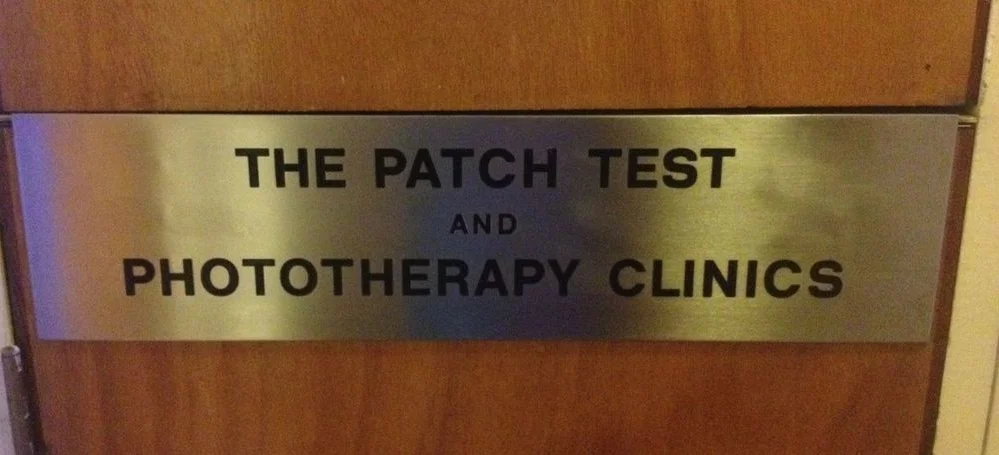
Welcome to The Patch Test and Phototherapy Clinic.
We are a private, nurse-led clinic specialising in Dermatology situated in the heart of London.
The clinic offers nurse led treatments In:
- Phototherapy
- Photochemotherapy
- Patch Testing
- Patient education sessions on skin diseases e.g. eczema / psoriasis
- Advice on the correct application & usage of topical treatments
All treatments are carried out by Dermatology Specialist Nurses.
All patients must be referred by a Consultant Dermatologist for Phototherapy and Photochemotherapy.
We have contracts with all major insurance companies.
PATCH TESTING INFORMATION
Thank you for booking your appointments for Patch Testing, please read the following information before your first visit.
The entrance to the clinic is in Queen Anne Street, which is the first turning on the right from the Oxford Street end of Harley Street. We are on the first floor.
Patch Testing is a specialist procedure carried out by specialist dermatology nurses to find out whether your skin condition is caused or aggravated by an allergy to substances which have come into contact with your skin. This is called contact allergy (contact dermatitis/eczema).
Substances that cause an allergic reaction are called allergens. They can be found at home, at work or in leisure activities.
The object of the tests is to find out whether you are allergic to any substances which may come into contact with your skin.
We are interested in products that you used on the affected skin at the time the problem began. We are mainly concerned with the ingredients in these products, therefore the packaging or a list of ingredients is most useful.
You will need to attend the clinic three times, at the same time on each visit, over a 5-day period. On your first visit, patches containing a variety of substances will be applied to your back where they will stay until your second visit. The patches will then be removed, and you will be left with pen marks on your skin.
- Please refrain from taking any oral antihistamines 48 hours prior to your first appointment and throughout the week of testing. If you have been taking a course of oral steroids or immunosuppressant medication, please contact the clinic.
- We cannot patch test patients who have a suntan on their back. You should allow 3 weeks for the tan to subside.
- Your back should be free from any rashes.
- MEN- if you have a large quantity of hair on your back, we request you remove it
(ie shave) at least 2 days prior to the tests.
- We are unable to Patch Test if you are PREGNANT or BREAST FEEDING.
How to take care of your Patch Tests:
You must not bathe, shower or allow your back to become wet until after your final visit on Friday. You should therefore avoid physical activities that will make you hot and sweaty.
We recommend you bring/wear old tight clothing as the skin marker may rub off and mark your clothes, it also helps keep the patches in place.
Wearing an old tight top in bed will help to reduce the chance of dislodging the patches.
If the corner of a patch becomes loose, it can be secured using medical tape. However, if the whole patch falls off it should not be reattached.
PLEASE SEND YOUR REFERRAL LETTER/FORM TO US BEFORE YOUR APPOINTMENT AS WE CANNOT PATCH TEST YOU WITHOUT IT.
PLEASE INFORM THE CLINIC BEFORE YOUR APPOINTMENT IF YOU HAVE HAD TROUBLE WITH MEDICAL TAPE OR PLASTERS IN THE PAST.
IF INSURED YOU WILL NEED TO BRING INSURANCE DETAILS WITH YOU, BOTH MEMBERSHIP NUMBER AND AUTHORISATION NUMBER.
INFORMATION ABOUT ULTRAVIOLET B TREATMENT
UVB is an effective treatment for many skin diseases. It consists of thrice weekly exposure of the skin to a carefully controlled dose of ultraviolet light, usually over a period of approximately six to eight weeks.
What does UVB treatment involve?
- During treatment you stand in a cabinet surrounded by “strip lights” which emit UVB of a specific wavelength. You must wear the protective goggles provided. Men must wear a genital cover, a dark sock is recommended, during the light treatment. Please discuss this with the nurse.
- On treatment days you must not use any perfumes, cosmetics or aftershaves.
- If you start any new tablets you must inform the nurse, as some tablets increase the skin’s sensitivity to UVB.
- On the morning of treatment please do not apply anything to the skin.
- Jewellery should not be worn in the treatment cabinet. Please avoid major changes in your hairstyle, as previously unexposed skin will be at risk of burning.
- You must not sunbathe or use a sunbed during your course of UVB treatment.
Short-term side effects are common but usually mild and self-limiting. They include:
- Transient redness of the skin with no discomfort. More persistent and uncomfortable redness (akin to sunburn) occasionally happens but settles over a few days.
- The skin tends to become drier and may be itchy. We recommend that you use a moisturiser after treatment and on non-treatment days.
Long term side effects are similar to those of natural sunlight exposure. The chance of getting these is related to the cumulative amount of UVB and other light exposure you have had. They include:
- "Ageing" of the skin.
- Skin cancers. Fortunately these are unlikely with UVB unless you have a large amount of treatment, and are almost always of the type which are cured by simple excision under local anesthetic.
- UVB is safe for women during pregnancy
On Admission:
If you are insured, please bring with you your Membership number and email authorisation letter (please note this may be different from the authorisation number for your Consultant consultation).
INFORMATION ABOUT PUVA TREATMENT
What is PUVA?
PUVA is an effective treatment for many skin diseases. It consists of twice weekly administration of a medicine called psoralen followed by exposure of the skin to ultraviolet light A (UVA).
What does PUVA treatment involve?
- You take psoralen tablets before your treatment – the nurse will advise you when to take them
- For 24 hours after taking the tablets except when you are asleep you must wear glasses which protect your eyes from ultraviolet light. The glasses must fulfil the UV400 standard – the nurses will check this before you are provided with the tablets.
- For the rest of the day you must protect your skin from sunlight. Stay inside as much as possible. When outside for any length of time wear long sleeves, gloves and a sun hat and use a sunblock. Avoid direct sunlight transmitted through window glass and do not have concurrent light or sunbed treatment.
- During the light treatment you must wear the protective goggles provided. Men must wear a genital cover. Please discuss this with the nurse.
- On treatment days you must not use any perfumes, cosmetics or aftershaves.
- On the morning prior to treatment please do not apply anything to the skin.
- If you start any new tablets you must inform the nurse. Some tablets increase the skin’s sensitivity to light.
- Jewellery should not be worn during treatment.
- Please avoid major changes in your hairstyle, as previously unexposed skin will be at risk of burning.
What are the risks of PUVA therapy?
Short term side effects are common but usually mild and self-limiting. They include:
- Transient redness of the skin with no discomfort. More persistent and uncomfortable redness (akin to sunburn) occasionally happens but settles over a few days.
- The skin tends to become drier and may be itchy. We recommend that you use a moisturizer after treatment and on non-treatment days.
- Some patients find psoralen tablets make them feel queasy. This is less likely if they are taken with a snack. If it happens please inform the nurse who will arrange for an alternative tablet to be prescribed.
Long term side effects are similar to those of natural sunlight exposure. The chance of getting these is related to the amount of PUVA and other light exposure you have had. They are unlikely to occur if you have had less than 200 PUVA treatments (approximately ten courses) in a lifetime. They include:
- "Ageing" of the skin.
- Skin cancers. Fortunately these are almost always of the type which are cured by simple excision under local anaesthetic.
PUVA is not suitable for women during pregnancy.